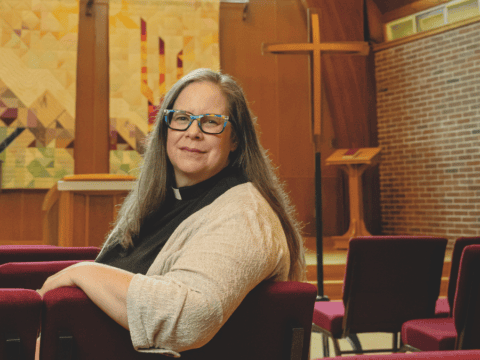
After 37 years of pastoral ministry, I left the church. I was emotionally exhausted and burnt out, and so I retired and studiously avoided church in my new community, Hamilton. But as the world became more threatening and confusing, I found myself missing congregational life. In February, I took a part-time position at Faith United.
Around the same time, I had begun hearing reports of new people arriving in worship services across the country. At first, I was skeptical. Much of my ministry had involved adapting to the decline of the United Church. With an average Sunday attendance of 47 people in 2024, we can no longer deny that we are a small denomination today.
You may unsubscribe from any of our newsletters at any time.
And yet, beyond the statistics, I sensed a shift in the wind. Walking through Faith United’s doors, I was delighted to meet many recent arrivals. When we announced a new-member Sunday, I was genuinely shocked when 15 people came forward to join the church.
I now believe that the Spirit is reconstituting the church, and that the denominational transformation from large to small actually presents an opportunity. The church can finally write the new story it so desperately needs. We can experiment with all aspects of what it means to be a community of faith — and, yes, we can even attract new members.
But it’s important to understand the people who are now joining our small churches, what they are looking for when they walk into church for the first time, and what we have to offer that they can’t find within mainstream culture.
Among the newcomers I’ve encountered at Faith United, some are young adults and some are older. Some come from other denominational backgrounds, and some have no church affiliation. Some are members of the 2SLGBTQ+ community, and some of those are refugees from Africa.
They are not looking for a church that is large and anonymous, and the denominational label of the United Church is largely irrelevant to them.
What they want is a church community where they can be seen and heard, develop relationships and quickly integrate into the life and work of the congregation. They want to understand and experience God in a community that lives out its faith in its actions, not just in its words.
What, then, do small churches offer that people cannot easily find elsewhere?
More on Broadview:
- What small churches know
- What’s bringing kids back to Sunday school in P.E.I.?
- How congregants from a small-town church gave it an ‘extended life’
1. Small churches are countercultural
Newcomers arrive at church seeking a way through the morass of our new realities. We are all experiencing an economic system that’s designed to extract everything it can from us, while giving us precarious work, unaffordable housing and rising costs. We are facing forces that dehumanize, commodify and marginalize us. The belief that markets and privatization are the answer to most problems is so pervasive that we barely register it anymore, and yet it is as controlling as any authoritarian regime.
The church rejects this and says follow Jesus, who led people away from self-destructive and selfish behaviours — and transformed their lives because of it. For newcomers, the Gospels offer a fresh set of countercultural values. Small churches provide them with the intimacy to explore the stories, ask questions, and create intentional and meaningful values for their lives.
2. Small churches treat people as beloved members of a community
Advertising and social media thrive by telling us we are not enough. For-profit companies will never assure you that you are loved and that you belong. The prevailing cultural message is that every individual is out for themselves and genuine community doesn’t exist.
In a small church, you are seen, loved and accepted as you are. You are created, not in the image of TikTok or Instagram, but in the image of God. You are sacred and of great value to God and to the church community.
Those messages are powerful antidotes to the sense of isolation, loneliness and “not-enoughness” that are so much a part of our contemporary world. The small church carries you when you can’t walk on your own, when life’s blows are too much to bear.
3. Small churches turn despair into repair
It’s easy to be overwhelmed by the size of the challenges we are facing: rising inequality, the climate crisis, war and genocide, to name just a few. What is now being termed the “polycrisis” can cause an all-encompassing sense of helplessness.
The small church offers an opportunity to reshape the world by taking tangible action on some of these issues. A small congregation may have a ministry with Indigenous Peoples working toward reconciliation, or with those struggling to make ends meet in a difficult economy, or with the 2SLGBTQ+ community. By participating in even small actions to help repair the world, we help to heal our own souls.
4. Small churches offer sacred practices
Whenever we pray to God, we acknowledge that there is something beyond ourselves, and that we are both grateful and accountable to our Creator. We are reminded of the needs of others.
In a small church, communal prayer is more intimate because we know the people for whom we are praying. They are our friends and family, and we can see them in our mind’s eye as we pray. Equally, those being prayed for in a small church have a greater sense of being enveloped by the love and care of a faith community that knows them well.
We also sing to God. Have you ever heard a small congregation belt out a hymn they know and love? It’s so moving to listen to people with imperfect and very human voices singing their hearts out with real joy. The walls themselves reflect the generations who have sung in the same space, Sunday after Sunday. It will give you chills and bring tears to your eyes.
Where else, besides church, do people get to sing each week, without needing to perform? What a gift!
5. Small churches are resilient
Small churches can be nimble, relational and creative. With fewer layers of bureaucracy, they can make decisions quickly and respond to the current needs of the congregation. Many small churches have a history of thriving, despite smaller numbers and financial challenges. They know how to adapt.
Rev. Daniel Reed is the associate director of mission, property and finance for the Toronto United Church Council. As a minister in his 30s, Reed has only ever known a declining denomination and so functions comfortably in a world of re-creation and innovation. In his role, he has worked with several small communities of faith he describes as “scrappy and innovative” and “doing really cool things.”
For example, Reed notes that Sprucedale (Ont.) United is a tiny church that has created a community café. Mount Zion United in London, Ont., is erecting a new building for an EarlyON Centre, a provincial service for families with small children. And four churches in London, Ont., are employing three ministers as a new way to share leadership. “I am seeing churches prayerfully moving outside their comfort zone and letting themselves be open to both failure and transformation through the movement of the Spirit,” Reed says. “In my work, I see that resurrection is real.”
After decades of Good Fridays, the Easter hope for small churches may not be a return to former strength. It may be something humbler, but also more surprising: a willingness to loosen our grip on old models and discover new purpose by truly welcoming newcomers — and letting their presence, questions and gifts help shape what comes next.
***
Rev. Christopher White is a writer and minister in Hamilton.
This article first appeared in the September/October 2026 issue of Broadview with the title “The Little Churches that Could.”
Thanks for reading
Independent journalism rooted
in faith and justice is under threat
Broadview is the only media organization in Canada offering thoughtful, values-driven journalism from an inclusive, progressive Christian perspective. But our work depends on your support. If you value what you've just read, please act now.
A gift today helps keep this journalism alive tomorrow.
With gratitude,