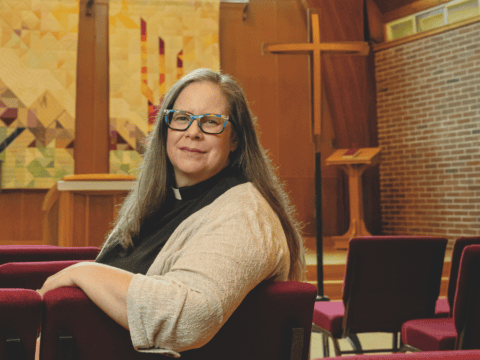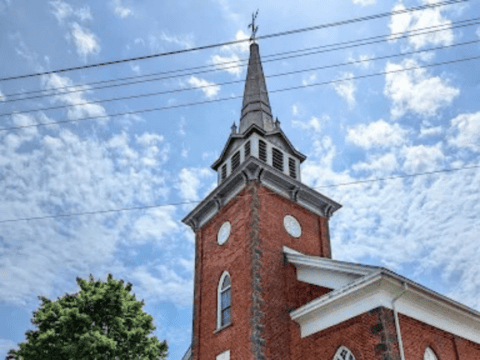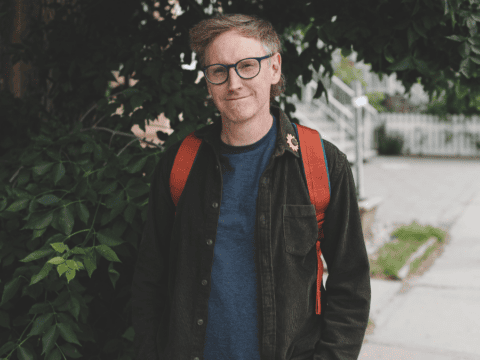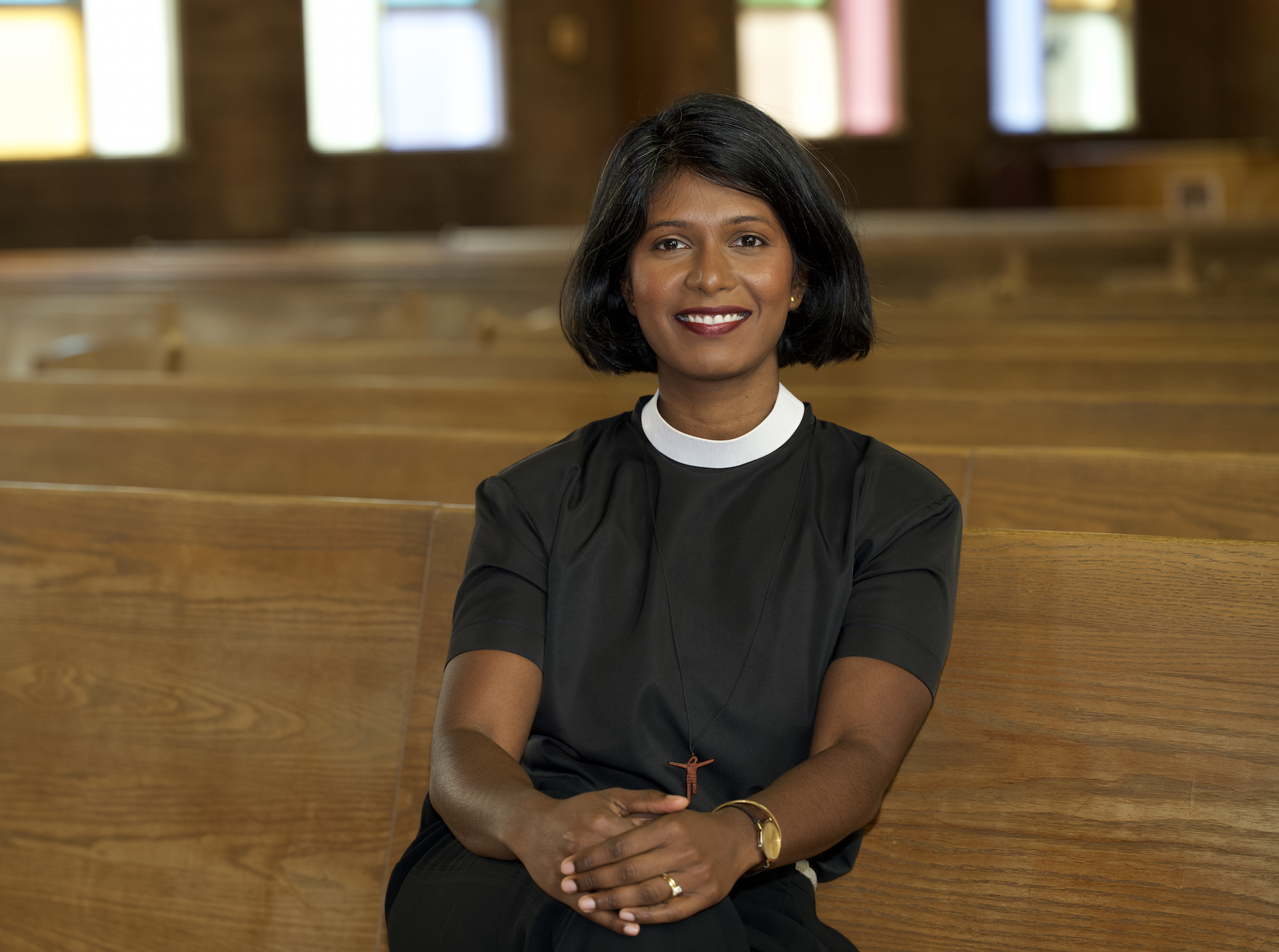
Rev. Gerlyn Henry is an Anglican priest in Scarborough, Ont., where she has spent the past six years doing what she describes as her calling: serving a congregation. But outside her church, Henry has built a very different kind of congregation. More than half a million people follow her on TikTok and Instagram, where she posts near-daily videos about politics and religion, often from a progressive perspective.
Broadview’s recent summer intern, James Adair, spoke with Henry about her experience being an influencer priest.
You may unsubscribe from any of our newsletters at any time.
JA: If someone has never seen your videos, what should they expect?
GH: For people who don’t really know me, I say I make content about faith and politics and clergy lifestyle, but I think my content is somewhat layered at its core. It tries to demystify church and faith. For so many people today, they look at the church and they see this institution that is very rigid that only a few people with power can fully understand or fully access. I try to demystify that.
I tell stories. I use a little sarcasm. I share mistakes that I’ve made. I kind of show the behind the scenes of the drama that we see on a Sunday morning.
I’m doing that so that people can see church at what it could be at its best, which is justice and community and love and inclusion, and to also make sense of faith and politics.
JA: The impression I get is that a lot of your audience is secular or they perhaps grew up going to church, but haven’t been in years. Why do you think you’ve attracted such a large secular audience?
GH: I’ve been making content for four and a half years and a lot of the early content was exclusively about church and being a clergy person, and that didn’t have a huge following.
I think for years I was stuck at a 40,000 follower count, but it shifted when Trump came into power a second time.
A lot of religious people come to content creation with some sort of agenda, a hidden push to convert or to offer a judgment to bring people back into the pew. I try to offer hospitality without the conditions.
I also offer levity. We live in such a heavy cultural moment where talking about politics and theology can feel heavy. So I use humour and personal storytelling and a little bit of weight to lighten this conversation without flattening it. That strategy is really helpful in breaking down the defensiveness that people have when we come to talk about faith or politics.
The biggest reason why people who are secular follow me is a shared pursuit of justice. People today are hungry for spaces that model systemic dignity and safety and inclusion, and secular people stick around because they see someone who’s in a collar, who is passionate about human rights and mental health and has the vulnerability to name the mistakes that have happened from the institution of church.
JA: There’s a lot of discussion about big tech and social media and algorithms especially. Do you ever find it difficult to reconcile the nature of the medium that you’re using with the good news that you’re hoping to spread?
GH: Yeah, absolutely.
All the time. One clear boundary I’ve drawn for myself is I’m not ever going to move onto X [formerly Twitter] in protest of Elon Musk. But I wrestle with the tension every day. There’s this profound irony though, I think, in using platforms that are designed for outrage and short attention spans… for preaching a gospel of inclusion and justice. I think that subversion is deeply Christian.
That’s a strategy that we’ve lost. While the content that gets the most attention online is rage and clickbait, as Christians, our ministry online isn’t just to enrage people or get them to view our content. Rather, it’s to do the work of reconciliation through our content — not reconciliation as in making two people who believe differently to perform peace. But reconciliation between us and God. So when people talk to me about doubt, I see it as an opportunity, because to name that doubt is prophetic in itself. Because doubt usually leads to action.
Often that action is leaving a broken system or standing up to it and working to fix it. I think both responses are great.
Something I’ve been thinking about is I think progressive Christians aren’t as well known in the world right now because we don’t use the platforms that conservatives or people who don’t preach the same agenda as us are using.
So much money and resources are poured into creating conservative platforms so that the world sees that opinion as standard. We think Sunday morning churches are our main platform, but I see social media as a digital front porch that you experience as you walk by — and then you get to do whatever you want with that information. But to do that, I have to be on the platform.
More on Broadview:
- When horses become therapists
- A Palestinian Canadian author’s journey of resistance through writing
- As wildfires tear through B.C., faith communities open their doors
JA: How do you balance having this in-person flock — your home church, which is your day job — and then this digital flock?
GH: I remember I had to learn the difference in a moment of mistake.
I would say I’m really good at my job. I know what it means to be a parish priest. There are boundaries. When I first started, I didn’t have that same sense of identity. I was like ‘I’m kind of a pastor, but I’m also kind of a prophet and I’m an influencer.’ And I remember I responded to an older person’s [online] comment in kind of a sassy way, and it hurt their feelings so much that they wrote to me privately and then blocked me.
They said: ‘I was just trying to talk to you, and I was really hurt by what you said.’ That moment helped me reassess how I see myself online. Another time, somebody had said I needed to be deported. It was somebody I went to high school with. I thought it was so funny and odd that somebody who knew me years ago would say that I need to be deported for being affirming. And so I responded to their comment and gave this history of what it means to be affirming in the Indian context, and it went mega viral. People were so mean to my high school classmate. They went back to her video and to her profile and flooded it with comments, so much so that she had to deactivate all of her accounts.
I felt really bad because I didn’t recognize the power that I had online, which I don’t have here in church. And so online now, I’m really careful not to say, ‘I am your pastor.’ I don’t say that in private messages. My content isn’t in the capacity of pastor and flock. I am a social media content creator. I am offering you glimpses of faith, and the invitation to come and see me in person — but this dynamic isn’t pastor-flock.
I cuss online — I don’t cuss in church, for example.
JA: How has your social media content impacted your real life or your in-person congregation?
GH: For a majority of my in-person congregation, I think out of 100 people, for example, maybe 20 people know that I make content.
It’s not widespread knowledge, and I don’t ever talk about it in church. I think I really value just seeing and being with somebody who only sees me as a young pastor and nothing more.
But we get a lot of visitors. In the past year we’ve had 100 or so people see me online and then come to church to experience what that’s like.
And the parish has been very welcoming to them.
People have been recognizing me more in the world, and each time I’m flooded with a sense of humility and responsibility.
JA: It’s almost like being a celebrity.
GH: Yes, but I should share the harder sides of it.
I posted a video a couple months ago about women, body positivity, Planned Parenthood, and it went mega viral outside of my world.
It ended up getting me doxxed [having one’s personal information shared online]. Somebody came to the house where I lived and said I’m going to burn this down. I get a lot of threats online, but it exposes my family and congregation to that kind of action, which I thought was deeply unfair. I had to really wrestle with managing that risk of how worth it is to say things that I know are risky when it will have a direct impact on people who haven’t consented to being a part of that risk. I’ve had to wrestle with that.
Recently, with my Palestine content, the accusations of being antisemitic have been rising each time a video takes off. More recently, those accusations have gone to my head office. The diocese has encouraged me to be more careful.
JA: How do you make the decision when a topic is worth discussing from a Christian perspective?
GH: I think if an issue touches human dignity or systemic power, the flourishing of God’s Creation, the church is already implicated. It is a place we should already exist. And silence isn’t just neutrality. Silence is a public statement of choosing the status quo, which I think is what some people want —of the church to just be in the system and let the system do what it does. But when I look at things like the housing crisis, economic justice, Palestine, migration, immigration, all of this, I have a couple of tests.
The incarnational test. As Anglicans, we are big on theology of incarnation. We believe that God took human flesh, real body, living under real political occupation.
So when housing becomes an investment, while shelters are full and are under budgeted, that is a place where the church must speak. We know what it means when Jesus says you should feed the hungry and clothe the naked. So that’s one, the incarnational test. The second is the power test.
In the prophetic tradition from the Old Testament all the way to the New Testament, it always asks who holds power and who is being crushed under power. And so when the church only speaks about topics that are safe and sanitized, I think we are implicating ourselves in a system that actively tries to suppress conversations about land dispossession and economic exploitation.
We become like the arm of the institution instead of being the prophetic voice of the institution. When I was an intern in a World Council of Churches conference, the conference was titled Mission from the Margins. That title kind of blew my mind because I’d always imagined God as closest to me and moving outward towards people who don’t know God. But the conference talked about how God is most evident in the margins of our society and mission comes inward to those who are privileged with power.
JA: When did you realize that you had gone viral?
GH: I was going to my car one day in Toronto when a woman approached me and said: ‘Are you a pastor? I didn’t know you could wear that.’
I had my collar on. And I said, ‘No, we can wear anything. There’s not really anything we can and cannot wear.’ And then she said, ‘Modesty is a virtue.’
It was the day before I was going on vacation, and I was feeling a little sassy and said, ‘Would you rather I go to a nude beach?’ She was just so aghast. But that video [describing the incident] kind of caught everybody off guard and put me on the map.
***
James Adair is a recent Broadview summer intern.
Thanks for reading
Independent journalism rooted
in faith and justice is under threat
Broadview is the only media organization in Canada offering thoughtful, values-driven journalism from an inclusive, progressive Christian perspective. But our work depends on your support. If you value what you've just read, please act now.
A gift today helps keep this journalism alive tomorrow.
With gratitude,