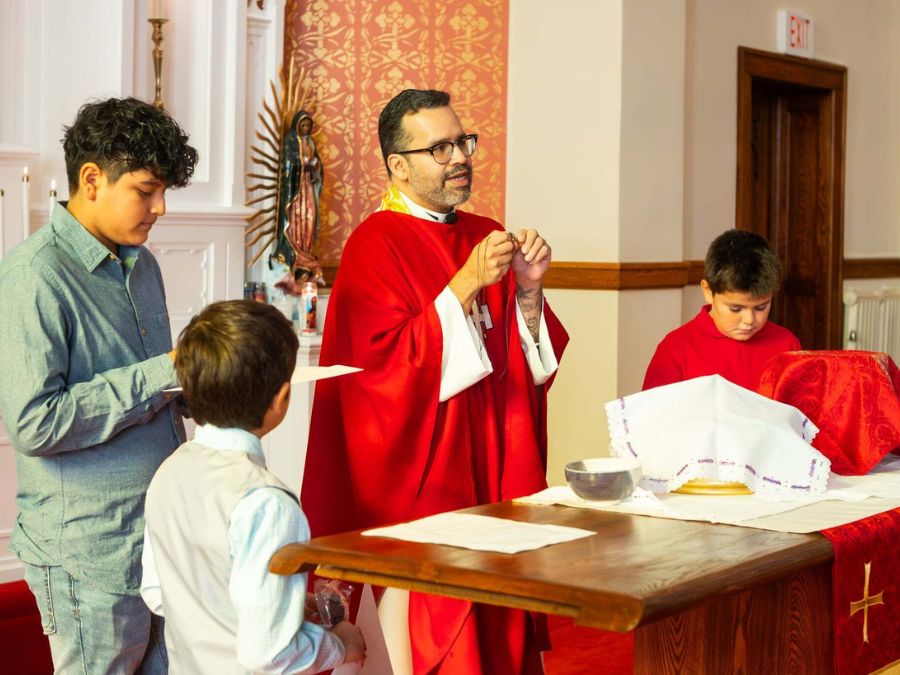
Rev. Hierald Osorto is the senior pastor at St. Paul’s – San Pablo Lutheran Church in Minneapolis. In recent weeks, the Minneapolis-St. Paul area has seen a massive Immigration and Customs Enforcement presence as part of the Trump administration’s immigration clampdown. Thousands of agents are on the streets detaining people. St. Paul’s – San Pablo, located in the diverse Phillips neighbourhood, has been providing support to residents who are staying home out of fear.
Osorto spoke with Emma Prestwich about how he and his faith community are supporting their neighbours during this time of heightened anxiety.
You may unsubscribe from any of our newsletters at any time.
Emma Prestwich: What has it been like to serve as a minister in this time?
Hierald Osorto: There’s a part of me that wants to say it feels just like any other day and I say that because I think I really want to push against the church’s response as being a response that is only of this moment, versus a response that has always been our responsibility as a community of faith to act when there is need.
However, under the conditions that we are in here in the Twin Cities, that need has just exponentially grown within a matter of weeks, moreso because of the conditions that have prevented people from being able to go to their jobs, from kids being able to go to school, and people being able to get food.
The church is in what is described as the heart of one of the most diverse immigrant communities here in Minneapolis. There are many, many languages spoken. I’ve heard numbers as high as 60. We’ve been in this community for 139 years, and we were founded by Swedish immigrants that arrived in 1887. And so that through-line of our immigrant story speaks strongly to this community’s presence and its responsibility to care for neighbours, regardless of whether or not they worship on Sunday morning.
And so that has looked like making sure that the local neighbours, those who organized getting food for folks within a certain block radius, have a place to coordinate and gather every other week. We had never hosted a food distribution before, but within hours that first time, the community came together. Members who are unable to travel far but feel safe coming to the church were able to participate. Some children in particular have needed additional care for their well-being because they’ve not been able to actively go to school. We’ve also made sure that people have access to medical support, hosting opportunities for consultations on Sundays. In particular, after our service, we’ve provided free acupuncture for some of our leaders, whom we’ve noticed are experiencing an incredible amount of stress during this time. Legal support, coordinating prescription pickup, coordinating hospital medical appointments, you name it, I think we’ve done it in this time.
EP: What has your resistance to ICE looked like out in the community?
HO: I don’t consider myself a public figure. I actually prefer to keep a low profile for a variety of reasons. I have found that my role as a pastor and as a clergyperson is to insist on keeping our doors open on Sunday mornings, despite the rhetoric we have heard. If there’s a need where my voice — recognizing that I do have a public role as a clergyperson — is required, I will participate, but I’ve had very minimal public participation.
However, last week, I was part of a press conference that included several religious leaders — recognizing, too, that at least the face of religious clergy and faith leaders involved right now, there are very few Latine/Spanish-speaking pastors at the forefront, at least publicly, right? I know that there are many of my colleagues from other traditions that are on the ground and providing incredible support. But I will say that my resistance is showing up on Sunday morning and continuing to insist that this is a space that is sacred, this is a space that is a sanctuary, and whether or not the government chooses to honour that role, we will continue to insist on making sure that it exists for our people.
More on Broadview:
- U.S. bishop goes viral with comments about ‘new era of martyrdom’ to resist state injustice
- Charlie Angus sounds the alarm on fascism
- Canadian churches have unfinished business with Indian day schools
EP: About 100 clergy were arrested last week protesting ICE actions. What do you think about their witness?
HO: A crucial testament of faith, it was an action grounded in our unwavering belief that the God we serve longs for everyone to experience an abundant life, not live under the continuous threat of empire. Each person’s actions contribute to the pursuit of justice.
EP: Have you or the church felt more directly vulnerable? Have there been ICE operations taking place directly outside?
HO: We have been living under this threat for a long time. It’s more exposed now and where we are situated as a community, there is a clear, active presence, much more visible, much more active, in the sense of neighbours being abducted from their homes and from their cars. We have witnessed what we have come to understand are likely agents idling throughout and I think that that visibility has for me, as an individual, just even heightened my awareness of security.
And I think for our community, there’s that nervous system rewiring of constantly needing to be on alert because you hear a whistle or constant honking, because that’s a sign that there’s an [ICE] presence. There’s both relief that there’s someone looking out for us, and at the same time, there’s this anxiety that really rises up that you’re mitigating, because it also means that the threat is close. And so that’s a constant, some days more than others. But I’ve always said, and most recently, I think on Sunday mornings, it does always feel like for even a few hours, there’s this sort of cloud of protection and respite that the community can just feel, this deep breath that people are able to take.
That, more than ever, is so essential to sustain this life that we’re living. And I think we’ll come out of this stronger, not that we need any more trials to be strong. But I’ve insisted in our community that this is not a moment that will just linger for the rest of our lives.
EP: Do you mean agents idling outside the church?
HO: Yeah, that might be the case sometimes. But I have been very careful of really not focusing on the active ICE presence because it is so known, right? The media is constantly portraying ICE agents abducting, creating havoc, murdering and so for our community and for me as a leader here, we know and we’ve named the presence, but that’s not why we move in the ways that we’re moving.
EP: Are there scripture passages or other pieces of liturgy that are anchoring you emotionally right now?
HO: The Psalms are ongoing anchors, and it seems like the lectionary has held us in appropriate ways during this time. And I’m thinking this past Sunday was Psalm 27 and that question that it opens with: “of whom shall I fear?” There are these ancestors in faith that have had these same questions that we’re living with under these times, and yet there’s this promise that there is more to this moment, that God has a dream for us that is beyond our imagination. I think that as a community, the Gospel has often shown us what it means to live a life of abundance, and you have countless stories from fishes and loaves, right, where multitudes are fed.
The care that we do is out of wanting everyone to experience that abundance, and it can be just as simple as making sure that people have their basic needs met and then saying, well, you know what, we should add a few more things there and not question whether or not we’ll have enough.
This interview has been condensed and edited for clarity.
***
Emma Prestwich is Broadview’s digital and United Church in Focus editor.
Thanks for reading
Independent journalism rooted
in faith and justice is under threat
Broadview is the only media organization in Canada offering thoughtful, values-driven journalism from an inclusive, progressive Christian perspective. But our work depends on your support. If you value what you've just read, please act now.
A gift today helps keep this journalism alive tomorrow.
With gratitude,