
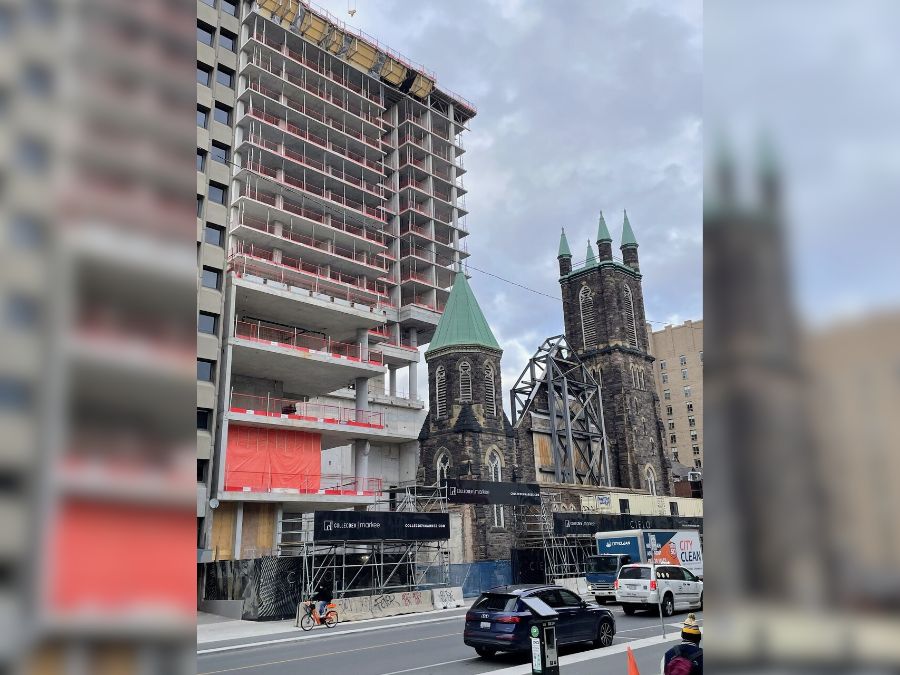
The Anglican Church of Canada is pulling out of an agreement to share office space with The United Church of Canada at a property still under construction in Toronto.
The two denominations are currently negotiating the Anglicans’ withdrawal from the contractual agreement, the United Church said in a press release Dec. 2.
You may unsubscribe from any of our newsletters at any time.
“We, the United Church, are disappointed that our hopes for a more broadly ecumenical church office will not be realized,” the denomination said in the statement.
“We remain committed to being housed at 300 Bloor St. West, and are deeply grateful to the congregation of Bloor St. United Church, who continues to work with us as we face these unanticipated challenges.”
At an Anglican Council of General Synod meeting on Nov. 27, chancellor Clare Burns said the General Synod was in negotiations with the United Church to leave the lease.
The 2024 lease agreement committed the Anglican Church of Canada and The Presbyterian Church in Canada to subleasing office space from the United Church, which plans to rent the space at 300 Bloor St. West from Bloor Street United Church.
But at a General Synod meeting in June, Burns shared that the organization had hired an accounting firm to investigate the approval process for the lease, alleging that then-general secretary Alan Perry and treasurer and chief financial officer Amal Attia had not run it by the Council of General Synod first, according to Anglican Journal reporting.
According to the Journal, estimates in the denomination’s 2024 financial statements suggested that the church would pay $8.18 million for a five-year lease, with $3 million in construction costs and yearly costs estimated at $960,000 to $1 million in base and additional rent. This cost would be significantly higher than the current carrying costs for its current office in Toronto, which it owns.
Harry Li, the United Church’s executive officer of finance, told Broadview last summer that the Anglican numbers related to the new space are wrong.
He declined to share the base rent for the office, which is just the occupancy fee and doesn’t include the tenant’s share of the building’s operating expenses (covered by additional rent), but said Bloor Street United and the General Council Office agreed to the base rent in 2012. Bloor Street is honouring the same rate, which is below the current market rate, he said, and the United Church is passing along that benefit to its subtenants.
Li mentioned that the construction costs are being overstated: “This cost would be amortized over the useful life of the entire leasehold improvement period. So that’s typically ranging from 10 to 15 years.”
Anglican Church spokesperson Henrieta Paukov said the church would “refrain from comment pending the outcome of negotiations regarding the lease agreement.”
Broadview has requested interviews from the United Church and the Presbyterian Church and will be following this story.
With files from Gillian Steward
***
Emma Prestwich is the digital and United Church in Focus editor at Broadview.
Thanks for reading
Will you help support United Church reporting?
Broadview is the only media organization dedicated to telling the stories of The United Church of Canada — its big decisions, perspectives and the faithful people and communities at its core. But this essential work depends on you.Make a tax-deductible gift today — 100% of your donation goes directly to supporting United Church coverage.

With gratitude,









Why has the decision taken so long reaching this point ? in the middle of construction ?, It seems to me someone or group are not doing their job’s,
Unfortunately, in almost all such projects, there are hidden costs which only come to light too late. Part of the problem is a plethora of «codes» which are really unnecessary for the safety (even «comfort») of occupants but cannot be avoided. Those unnecessary but unavoidable costs can add substantially to both construction and operating costs. Again, unfortunately, the fact that the Anglicans OWN their current offices means they have much less exposure to «unanticipated» costs, and so «staying put» makes a lot of sense.