
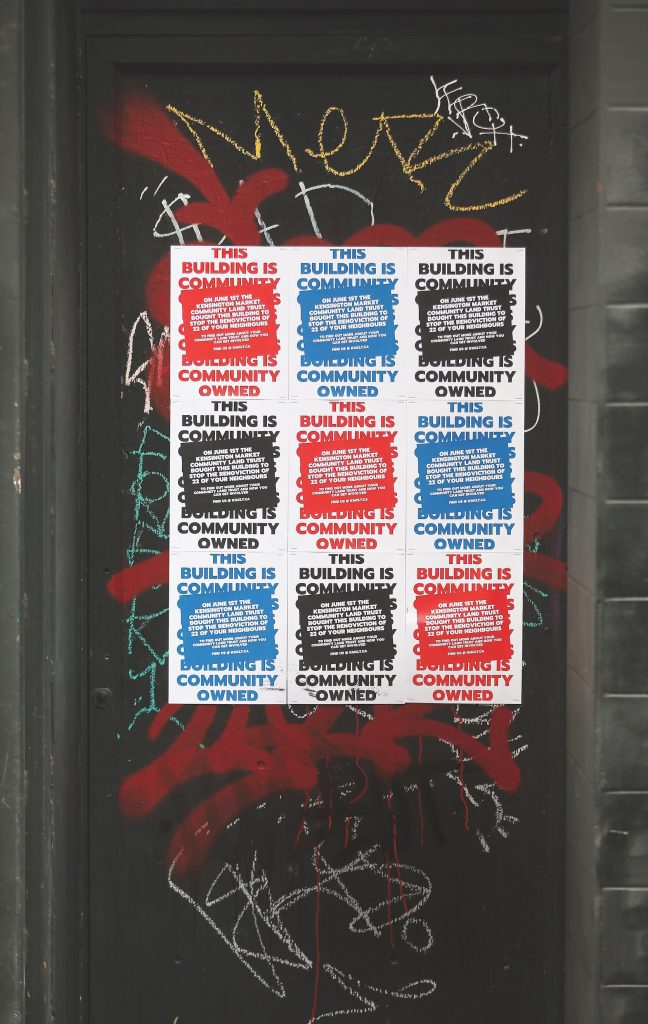
On New Year’s Day in 2019, the tenants of 54-56 Kensington Ave. in Toronto received eviction notices. But these notices weren’t legally legitimate — they were the generic type that anyone could print off the internet. According to community organizers, a group of real estate agents had reportedly purchased the building in hopes of creating a destination Airbnb hotel for cannabis users. They gave tenants three months to vacate their units.
“People have this idea that you can go buy a building — it’s like buying a rug, you just shake out the people that live there — then you can do whatever you want,” says Kensington Market community organizer Dominique Russell. But as someone who has received an eviction notice from another building in the past, Russell still remembers how she felt holding the slip of paper: “It’s like the bottom is falling out of your world.”
You may unsubscribe from any of our newsletters at any time.
Located in the heart of downtown Toronto, Kensington Market has hosted a wide range of cultures and subcultures since Jewish immigrants began turning their ground floors into storefronts in the early 20th century. Today, the market continues to be a vibrant space of small shops and sidewalk stalls selling food and goods from around the world. “Kensington Market has always been fundamentally a working-class and new immigrant space,” says urban planner Chiyi Tam. “If that core integrity of the neighbourhood is lost…if it is no longer at its core serving the working class, then is it still Kensington Market?”
Anyone who has visited the market might recognize the building at 54-56 Kensington Ave. Rising three stories in the centre of the neighbourhood, it has an iconic Mona Lisa mural painted on its south side. Inside, 12 bachelor suites and a pair of two-bedroom units sit atop a handful of ground-floor commercial spaces. Prior to 2019, these commercial units were occupied by small businesses. But the building’s new owners removed them and renovated the spaces. Today, if you walk past, you’ll notice new security cameras perched in the top corners of doorways.
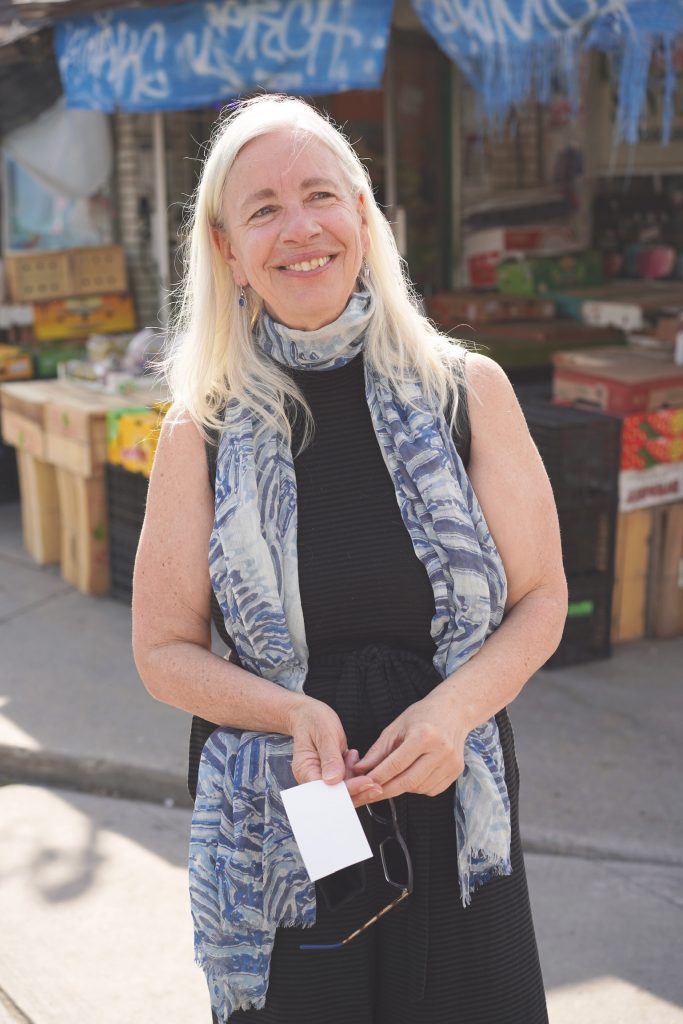
As stories like this become increasingly common, some people might assume that they are a natural part of big-city living: a landlord buys a property, wants to redevelop it and has to push out the old to make room for the new. But there’s nothing natural about these disruptions to regular people’s lives and livelihoods.
For a moment, imagine a world in which events like these didn’t unfold. What if we didn’t leave renters at the mercy of the real estate market? What if their lives couldn’t be upended by a new landlord’s desire for profit? What if you, as a renter, knew that the building you were living in could not be sold? What if it belonged to your community long-term, and you knew that you had a direct say over what happened to it?
Across Canada, community organizers are working to make this vision a reality. Using a non-profit model called the community land trust (CLT), they are acquiring land to keep it permanently off the market, while ensuring that community members can exercise democratic control over the use of that land. Often, these trusts are used as a strategy to protect affordable housing, which is in short supply in urban and rural spaces alike. The CLT can take many shapes, but in its classic form, the trust will purchase parcels of land in a specific geographic area. It will sell or lease the buildings on that land to private homeowners, non-profit housing providers or government entities. All the while, the land is governed by an elected board, which maintains responsibility for ensuring that housing remains affordable and safe.
Many of the newest Canadian land trusts are helmed by community organizers who, like Russell, have longstanding connections to their neighbourhoods. Their work is guided by paradigm-shifting questions: Why do we treat land as private property that should be administered at the discretion of an owner? What happens if we instead treat land as a resource that should be shared for the common good? As CLTs gain momentum across Canada, organizers are moving us toward that imagined future: it is possible, they contend, to decommodify housing and reposition it as a human right. It is possible to preserve affordable housing, reduce homelessness and fight displacement — permanently, and in community.
The CLT has only formally existed for 50 years, but the underlying ethos is far from new. At the turn of the 20th century, England constructed Garden Cities: little towns built on municipally owned land and governed by trustees. In mid-20th-century India, inspired by Mahatma Gandhi’s vision that land be held in trust for the poor, landowners donated land to villages as part of the gramdan (“village gift”) movement. A village council would then govern that land, leasing it out to local farmers. Meanwhile, in Israel, collective settlements called kibbutzim, which hold all wealth in common, have existed since 1909.
The CLT as we know it today owes its existence to an African American organizer named Charles Sherrod. In the early 1960s, Sherrod served as a project director for the Southwest Georgia branch of the Student Nonviolent Coordinating Committee, a grassroots movement fighting the political and economic disenfranchisement of Black people in the Deep South. As part of his work, Sherrod observed that when Black sharecroppers and tenant farmers attempted to register to vote, they were systematically displaced from their land. He believed collective ownership might offer a solution and visited Israel to study its kibbutz system. In 1969, he and other organizers established New Communities Inc., a land trust to “prevent displacement and promote Black economic prosperity” in Albany, Ga. It was the largest Black-owned land holding in the United States at the time.
In the following decades, other communities — first rural ones, then urban — realized that they could adopt similar strategies to preserve access to land. By 2014, one report estimated that the United States had over 260 CLTs. Others popped up all over the world, including in Australia, England and Belgium. In Canada, they appeared in two waves. The first handful arose in the 1980s, but at the time there was insufficient public policy and legislative support to establish CLTs. These early trusts primarily focused on administrating co-operative housing on CLT-owned land. Fast-forward to the early 2010s, and low-income racialized communities in Canada’s urban centres were facing intense pressures from gentrification. A second generation of land trusts took form that incorporated a broader range of issues into their mandates. Today, not only are these trusts concerned with affordable housing, but they also address food security, solidarity with racialized communities and displacement.
That last factor — displacement — can be traced back to political decisions at the federal and provincial levels. Decades ago, the federally controlled Canada Mortgage and Housing Corporation funded and administered social housing across Canada. In the 1990s, however, neoliberal political shifts led to decentralization, and provinces and territories became responsible for organizing their own systems of social housing. In Ontario, these responsibilities were further downloaded to the municipal level, and the lack of funding and accountability created vast gaps in the affordable housing supply.
Today, Canada’s housing crisis has escalated to unprecedented heights, with affordable units disappearing far faster than they’re being replaced. Tam says that CLTs are responding to that reality, stepping up where governments have failed. While funding programs tend to focus on new affordable housing, there’s nothing to prevent the loss of existing housing, she points out. “You’re not stopping the water from leaking out of the bucket in the first place.” (The recent federal budget, while prioritizing new construction, does earmark funds for repairing up to 17,800 units for vulnerable Canadians.)
Toronto’s Parkdale is another urban neighbourhood hard hit by gentrification. The 2016 census showed that over 30 percent of Parkdale’s population was low-income, compared to 20 percent in Toronto at large. Almost half of neighbourhood residents were spending 30 percent or more of their income on shelter.
In the years after the 2008 recession, then-University of Toronto student Kuni Kamizaki studied how gentrification was affecting this neighbourhood. In his conversations with residents, he found that the shifts occurring in Parkdale were “really a question of who owns what.” Real estate investment was driving change, and tenants “didn’t have control over their own everyday life,” he recalls. Kamizaki secured a grant to hold community consultations on the idea of creating a CLT. By 2014, the Parkdale Neighbourhood Land Trust (PNLT) — the first of Canada’s second-generation land trusts — was established.
Joshua Barndt joined the staff of PNLT in 2015 and became the executive director three years later. He says the organization’s main focus is to decommodify land and respond to community needs. Just after PNLT achieved charitable status in 2017, it began investigating rumours of illegal evictions and closures of rooming houses, which were mostly occupied by low-income renters. A 2017 study by the trust revealed that Parkdale was home to over 2,700 dwelling rooms — more than double the units owned by Toronto Community Housing in the area. These units, Barndt said, represented Parkdale’s “largest affordable housing stock at that income bracket.” But instead of that stock being maintained and protected, it was “being aggressively eliminated.” Real estate investors were purchasing buildings at low cost, pushing tenants out — often via unlawful evictions — and renovating the units to attract higher-income residents. PNLT estimates that around 350 renters from 28 rooming houses had been displaced in the past decade alone.
“What people anecdotally knew was a problem was actually a crisis, and it needed a neighbourhood-wide intervention,” Barndt says. The solution? To acquire and preserve what rooming houses they could, and make sure that tenants in other buildings had the support to defend their tenancies. The group hired local organizers and residents to share tenant rights information with renters at risk of displacement, with the hope of encouraging people to fight to stay in their homes. By May 2019, the trust announced that it had purchased a 15-unit building on Maynard Avenue. The City of Toronto provided $1.5 million toward the sale, and the province contributed another $600,000 for building improvements. A PNLT press release stated that existing tenants would continue to pay affordable rents, and people who had experienced homelessness would receive priority consideration for new tenancies. A 36-unit building at 22 Maynard Ave. followed in April 2021, and on April 1 of this year, PNLT took ownership of 81 single-family homes, transferred from the Toronto Community Housing Corporation. “When you take the element of fear of a bad landlord away, when you try to work with affordable rents, when a unit is maintained, when a relationship isn’t acrimonious — because they shouldn’t be, it fosters community,” resident Lynne Sky of 22 Maynard Ave. told the Globe and Mail last year.
PNLT board president Ana Teresa Portillo points out that when a tenant is displaced from a “deeply affordable” unit, the loss of such housing makes it difficult to find new accommodations. Twenty years ago, it may have been possible to secure an equivalent apartment in the neighbourhood. Now, “tenants get dispersed across the city [after being evicted], and we lose track of them,” she says. “It feels like being dismembered as a community.” So these small victories — a rooming house acquired here, a group of tenants organizing to resist displacement there — do a lot to keep the neighbourhood’s fabric intact.
The Canadian Network Community Land Trust serves as a “knowledge-sharing forum” for CLTs like Parkdale’s: community organizers lean on each other, learning from one another’s successes and mistakes. The network currently lists 21 CLTs on its website, mapping them out from coast to coast. No two of these Canadian CLTs are exactly alike: for CLTs to fulfil their purpose, they should be tailored to local needs.
For seven years, Jane Kali has been keeping a close eye on local needs as the executive director of the North Hastings Community Trust. Originally created to provide emergency financial relief to the northern portion of Hastings County, Ont., the non-profit has recently realized a dream to acquire property for a CLT.
“A huge chunk of the population is living without enough,” says Kali, who has witnessed first-hand the consequences of the rural housing crisis. North Hastings’ primary industry is tourism — especially in the summer, “people come here because it’s beautiful,” she explains — but this means that most employment opportunities in the area are part-time, seasonal and low wage without benefits. The tourists who pass through may be oblivious to the social issues facing the community, including overdose deaths, mental health struggles, violence and generational trauma.
“Homelessness is really invisible in a rural environment,” Kali says. Many people couch surf or pile up in apartments, despite the added COVID risk of congregate living. Some are sleeping in cars. “One woman who I met with recently, who’s 78, said she’s really tired of washing her dishes in a creek —she’s cold,” Kali says. She knows of two other women, also in their 70s, living in a non-winterized trailer; one requires an oxygen tank to breathe.
Meanwhile, Kali says, the area is currently facing “insane housing market forces.” In July 2021, CTV News reported that residential property values in Bancroft, the central town in North Hastings, had risen by 78 percent — or an average of $128,533 — in the past three years. The promise of massive profits motivates landowners to sell homes, and Kali says this puts anyone renting at risk of homelessness.
In the face of this situation, she believes a CLT would work wonders in North Hastings: “We know a community land trust is the only way to build land in the community so it cannot be sold — ever.”
Kali was a little hesitant to share this, but when we spoke in December, her team had found a building for sale that had “enormous possibilities” for the North Hastings community. In January, the trust announced that an anonymous community member had purchased the building for them. Kali says they plan on putting it into a CLT. “It’s such a big dream, but I feel like at this time in history, we have nothing to lose by dreaming big.”
Just as the design of a CLT must shift to meet local needs, the challenges that organizers face vary with local circumstances. In the Yukon, for example, Whitehorse’s Northern Community Land Trust is experiencing different challenges in its quest to build affordable homes. The farther you are from the equator, board member Tyler Heal explains, the shorter the construction season is. Materials also cost more, and there are fewer local contractors to design and construct buildings than in a major metropolitan area like Vancouver. But on the flip side, he believes that the small size of the community has helped Northern CLT build networks with the government, the private sector, First Nations and other non-profit groups. “It’s been easier for us to make some of those connections and relationships,” he says.
Displacement is all too common in Canada’s urban landscape, so the renoviction at 54-56 Kensington Ave. could easily have been the end of the story. But the owners overlooked something key. The building is a community hub known as “The Stoop”: “people sit on the curb of the building and hang out,” says planner Chiyi Tam. “There’s a group that’s known as the Kensington Market punks — who are, at this point, middle-aged people, but they have been longtime activists and counterculture leaders in the city of Toronto…So they weren’t going to get bullied out of their building.”
Friends of Kensington Market, a local organization founded by Dominique Russell in 2013, works to preserve the neighbourhood’s unique character. Alongside other groups, including Councillor Mike Layton’s office, it helped the building’s tenants organize to resist the eviction.
One evening, after putting his own children to bed, Layton personally knocked on residents’ doors to tell them they weren’t legally required to vacate their units. On Good Friday — “for some reason, this landlord really liked to ruin people’s holidays,” Russell says — the tenants were called into a meeting to discuss the terms of the eviction with the landlord. Russell, Layton and several other community members and organizers stood outside in the rain, waiting. During that meeting, the tenants held their ground and won the fight to stay in their homes. “If you’ve experienced being renovicted,” Russell says, “you know how hard that is.”
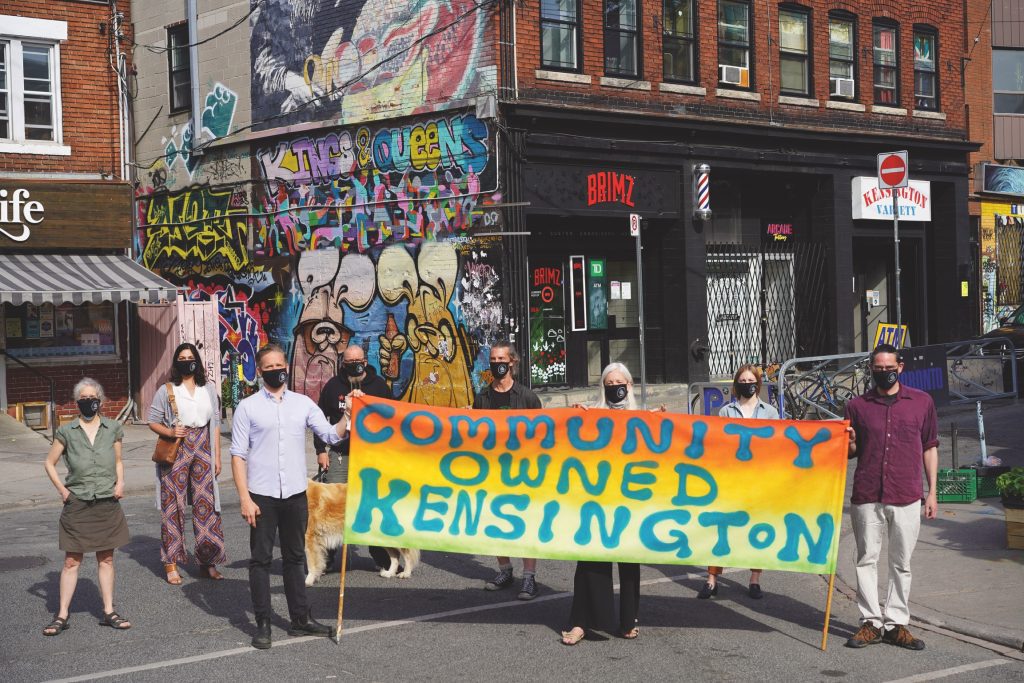
Some tenants had been living in the building for decades. Upon remaining in their units, they continued to pay deeply affordable rental rates, rendering the building unprofitable for the real estate group. In spring 2021, the property went up for sale. By June, the Kensington Market Community Land Trust (an initiative of Friends of Kensington Market) had an exciting announcement: with the help of $3 million from the city, they had acquired the building. Photos show Russell and other community members standing to the side of the building, holding a colourful banner that reads “COMMUNITY OWNED KENSINGTON.” The building will now permanently remain in community hands — and the idea of perpetuity is key for Russell. “It’ll make the difference between a livable city and a city that is just for the rich — that doesn’t have families, that doesn’t have young people,” Russell says. “That, for me, is not a city.”
Despite all that CLTs have to offer, Tam emphasizes that they are not a silver-bullet solution to issues of affordable housing and land ownership. Community governance, she says, may not look inclusive or transparent and can get a “bad rap” for infighting and neighbourhood drama. Kuni Kamizaki, who is now pursuing his PhD in planning, points out that the CLT model is still reliant on government funding to preserve and acquire affordable housing, so it is at the whim of the political climate. He also notes that CLTs don’t exist in a vacuum: they still have to compete with other private market actors in a speculative housing market.
Tam views CLTs as a “temporary workaround” to address the current state of housing inequality. “In a future where the right to housing is realized in a more holistic and structural way, there may not be a need for land trusts,” she says. “We shouldn’t be spending our time and energy desperately clawing back whatever little — bit by bit, property by property — that we can in our neighbourhoods.”
But for the time being, CLTs “can push the limits of what we can do,” Kamizaki says. It seems that the federal government is finally buying into their potential: this past year, the Canada Mortgage and Housing Corporation dedicated over $3 million in funding to 15 CLT projects across the country, including those in Kensington Market and Whitehorse.
Asked why she thinks CLTs are picking up speed right now, Tam says community housing interventions aren’t new and have taken shape under different banners, like the co-operative movement that was federally endorsed in the 1970s and ’80s. What makes this upsurge different is the sense that it’s accessible to a wider group of people. “Every neighbourhood in Canada that is marginalized and under threat of gentrification could pull this off.”
“If you feel like it’s hopeless for you personally to ever be able to buy property and real estate and not be housing insecure, you are able to do it with other people,” she says. “What we can’t do alone, community can do together.”
***
Jadine Ngan is a writer and university student in Toronto. She was one of Broadview’s summer interns last year.
Thanks for reading
Independent journalism rooted
in faith and justice is under threat
Broadview is the only media organization in Canada offering thoughtful, values-driven journalism from an inclusive, progressive Christian perspective. But our work depends on your support. If you value what you've just read, please act now.
A gift today helps keep this journalism alive tomorrow.
With gratitude,