
UPDATE (Jan. 7, 2026): The Presbyterian Church in Canada confirmed in a statement Dec. 12 that its Assembly Council “is guiding a process of reviewing the PCC’s options” amid news that the Anglican Church had pulled out of the office-sharing agreement and that “further details will be shared when they are available.” Amid the Anglican decision, “the PCC understands that important factors in the originally proposed ecumenical project have changed significantly.”
The Presbyterian Church in Canada is “in conversation” internally after news broke that the Anglican Church of Canada was pulling out of a joint office-share plan with The United Church of Canada, according to United Church general secretary Rev. Michael Blair.
You may unsubscribe from any of our newsletters at any time.
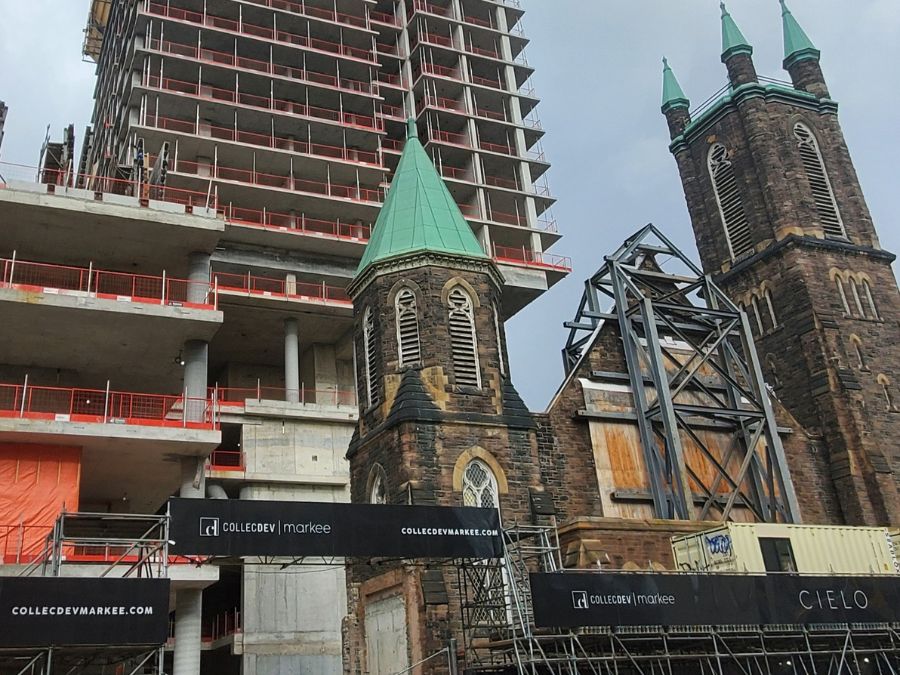
The three denominations signed a lease in 2024 to share an office at the redeveloped Bloor Street United Church in Toronto, with the United Church subleasing space to the other two denominations. The sublease was for an initial 15-year term, with the option for the tenant to terminate it as of the fifth anniversary of the start date without any penalties, except for certain circumstances.
But late last week, the Anglican Church revealed that it was in talks with the United Church to exit that lease agreement, with the United Church confirming the news in a press release on Tuesday.
Then on Friday, Dec. 5, Blair told Broadview that The Presbyterian Church in Canada was also weighing its options after learning the news.
“It shifts cost, right, when you are sharing three versus two,” said Blair, “and so they just have to do their own internal work around that.”
Blair added that the United Church won’t know the full amended cost of the office space until they redesign the space without the Anglicans.
In an email sent to congregants Friday, Bloor Street United Church council co-chairs Sandra Cruickshanks and Liz Tinker said “the ACC announced its withdrawal from [the lease] agreement with the likelihood the Presbyterian Church will do the same,” but that the United Church’s lease for the whole office space is still in place.
They said the congregation is currently working with a commercial real estate brokerage to look at other options for renting out the office space.
“The estimated current market rate for the commercial office space is at least 25 percent above the rate in the UCC lease so we are confident that the anticipated income to the Endowment Fund, which benefits [Bloor Street United], is not at risk,” they said.
The Presbyterian Church declined comment on Dec. 10.
Blair said Friday that he’s “just kind of disappointed that that dream” of an ecumenical centre for the three denominations “won’t become reality.”
More on Broadview:
- Anglicans pull out of joint Toronto headquarters with United Church
- West Hill United now has an executive director instead of a minister
- Burlington, Ont., United church unearths human bones during sidewalk restoration
He also updated the previous estimate of a late 2026 occupancy date for the United Church, saying that he now expects the General Council office to move into 300 Bloor St. West within the first half of 2027.
“So as you can imagine, with the Anglicans not present, we’d need to redesign the space and that may take some time and then renegotiate with trades to do the work,” he said. “So at this point in time, we won’t have a clear sense, although I think the builders are prepared to move fairly quickly in rhythm.”
At a national meeting in June, Anglican officials said they believed that then-general secretary Alan Perry along with Amal Attia, the denomination’s chief financial officer and former treasurer signed the agreement without authorization from the denomination’s General Synod. Rancour also erupted in the denomination over internal cost estimates for the lease. Perry’s employment as general secretary ended in September. Attia is still listed as an employee on the denomination’s website.
According to the Journal, estimates in the denomination’s 2024 financial statements suggested that the church would pay $8.18 million for a five-year lease, with $3 million in construction costs and yearly costs estimated at $960,000 to $1 million in base and additional rent. This cost would be significantly higher than the current carrying costs for its current office in Toronto, which it owns.
Harry Li, the United Church’s executive officer of finance, told Broadview last summer that the Anglican numbers related to the new space are wrong.
He declined to share the base rent for the office, which is just the occupancy fee and doesn’t include the tenant’s share of the building’s operating expenses (covered by additional rent), but said Bloor Street United and the General Council Office agreed to the base rent in 2012. Bloor Street is honouring the same rate, which is below the current market rate, he said, and the United Church is passing along that benefit to its subtenants.
Li mentioned that the construction costs are being overstated: “This cost would be amortized over the useful life of the entire leasehold improvement period. So that’s typically ranging from 10 to 15 years.”
Blair told Broadview that he didn’t know any more about the Anglicans’ reasoning than what the denomination had said publicly.
“What we know is that whatever their internal process was, it wasn’t followed, and they were also concerned about the cost and so that was their decision,” he said. “We’ve responded to any questions they have asked us.”
He said further questions remain about the relationship between the two denominations going forward.
“I think part of the challenge that we need to work on is how we continue to be good ecumenical partners, even in spite of the fact that we are not in a position or haven’t been able to agree to live together.”
EDITOR’S NOTE: This story was updated on Dec. 7 and Dec. 9 to add additional background details, and corrected on Dec. 9 to note that Amal Attia was replaced in her role as treasurer in November by Beng Wee. It was also updated Dec. 10 to add a response from The Presbyterian Church in Canada.
With files from Gillian Steward
***
Emma Prestwich is the digital and United Church in Focus editor at Broadview.
Thanks for reading
Will you help support United Church reporting?
Broadview is the only media organization dedicated to telling the stories of The United Church of Canada — its big decisions, perspectives and the faithful people and communities at its core. But this essential work depends on you.Make a tax-deductible gift today — 100% of your donation goes directly to supporting United Church coverage.

With gratitude,









I thought that with your rebranding, your magazine would work harder to maintain a “broader” perspective. It’s not really good enough to print a story only with quotes from the UCC moderator, and none from the other two partners in the story. Especially when you know very well the positions are contested. Is this the UCC definition of ecumenism?
I’m wondering if you could clarify your policy with respect to these comments. Is it your normal practice to remove comments that are even mildly critical of your coverage?
Hi Mark,
We did not remove the comment. It was flagged for manual approval and no one was present over the weekend to approve it.
Your comment should appear now.
Best regards,
Emma
Are there financial penalties for those denominations withdrawing from a lease written in the contract?
Depends on the conditions and legality of the contract.
Does it matter now? The UCC is stuck with what they’ve started, and it seems they’ll continue to move forward regardless.
Sad to read about squabbles between Christian Communities. Interesting to see what’s happening with this church though. I remember it as a tween and very young teenager when we lived at Whitevale, ON.
My Dad, Rev G Bruce McNeill would facetiously call this the UCC’s Mecca (only to family, of course).
One moment I remember vividly was when two little old ladies from the congregation stopped me outside to ask what had a happened to my brother John’s eye. John had a “lazy eye”. At that time this was treated by wear a pair of glasses with a patch over one eye, all waking hours of the day (1968ish). I don’t know where Mom and Dad were at the time but for some reason it was left to me to explain.
I was uncomfortable with the question, and at the ripe old age of 13 I thought they were very rude as it really wasn’t any of their business.